The danger of “good-enough” marketing
One of the age-old challenges to marketing is the danger of settling for "good enough" in content and creative. AI makes this worse.
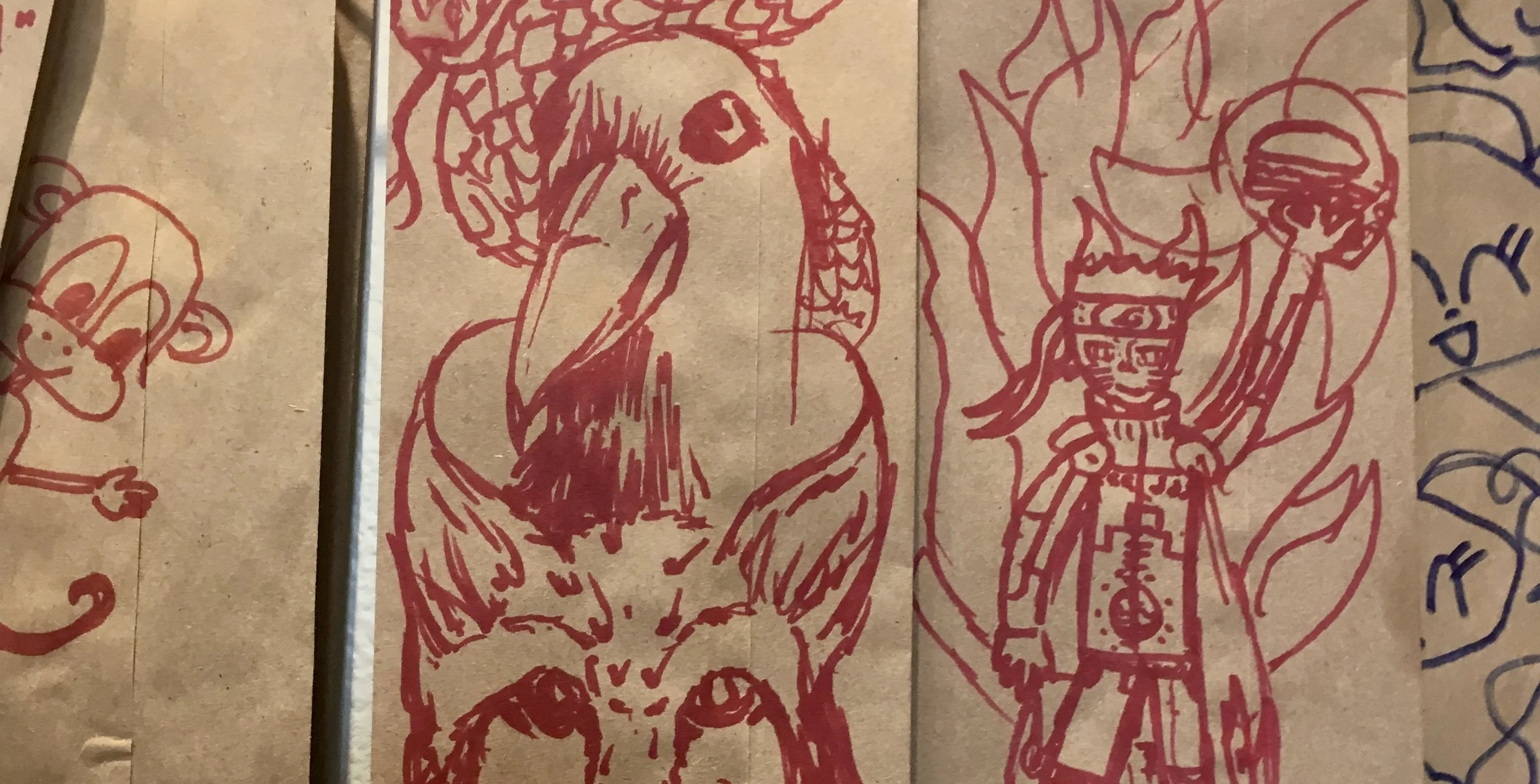
One of the sandwich makers at a place I used to go (sorry, now closed) would take a few seconds and draw on the sandwich paper packaging while he waited for the sub roll to go through the toaster. I don't have any data, but I'm sure this practice kept people coming back.
The danger of “good enough” marketing
One of age-old challenges to marketing is the danger of settling for "good enough" in content and creative. AI brings sharpens this pain as there are many tools out there that will quickly shine-up a weak creative idea. "Good enough" plagues a marketing team (and then a company) as good enough copy becomes so-so ads or so-so campaigns that lead to lower brand recognition, lower brand awareness, lower conversion, and ultimately, lower sales.
Ads created by AI perform worse than ads created by Humans
Adam Peruta’s Harvard Business Review article "AI-Generated Ads Perform Worse Than Human-Made Ones Even When Customers Can’t Tell Them Apart” is fascinating (and validating). It’s the first piece I’ve seen that correlates good enough ads created by AI to underperformance with buyers.
Peruta’s research shows that human-made ads are preferred by humans even when they don't know that the ad wasn't created by AI. They sense it. They feel it. And if ads (and marketing) are still measured by sales, this article is one to pay attention to as executive teams work on their 2027 budgets. The verdict: AI ads are good enough, but they don’t get humans to convert. They pass the test as content that can be defined as an ad.
What happens when positioning is AI-generated?
At its most fundamental, growth ads and brand ads, organic and paid social, email (though probably not cold email), billboards, podcast appearances, thought-leadership content should all act to drive interested prospects to your website where they’ll convert by form-filling or booking an appointment. If you’re in D2C, this is all a little more complicated, but you also have the good fortune of winning sales right from social. To someone in B2B marketing, the thought of winning a sale from social sounds like heaven. Peruta found that:
“Our research found that AI does a poorer job with weak, vague, or unsupported briefs. It also struggles to generate work that depends on emotional specificity, cultural timing, narrative tension, humor, emotion, or a surprising point of view.”
The step before all the campaign strategy and planning that goes into creating the assets that power the list of channels is positioning, val props, differentiation. Now imagine if Peruta extended his research into customer reactions to AI-generated positioning, val props and differentiation. AI looks to smooth rough edges, to increase conformity to established norms. But what if what makes your company special is a little weird, or just “special” or “unique.” Asking AI to create your positioning is to ask a system to look at what exists and create something from it, limited by what exists. As Peruta says, a long-time challenge for business leaders is that “creative is hard to scale.” But what happens if the push for scale and efficiency renders the creative output just “good enough”?
The danger in AI-generated positioning
The danger is that the campaigns that depend on positioning and differentiation suffer. Worse still if the campaign creative is AI-generated. The company achieves the efficiency target, but misses on the sales outcomes. Getting better margin on lower revenue base sounds fine at first, but over time it erodes top line results.
Worse still, your team won’t know what worked. The rigor of copy testing, A/B testing is diminished if one is just testing one AI-generated subject line against another. And if the creative team gets used to using AI to create your company’s campaign materials, there’s a risk that their skills degrade. The non-scalable time of a designer staring out the window or a copywriter taking an afternoon walk comes back double in locking in on strong copy that converts and design that moves a prospect.
And then “good enough” seeps into the rest of your work.
The power of AI tools to apply a layer of authenticity to shallow ideas is important too. A few years ago I worked with a marketing team that couldn’t get out of its own way. When I looked through past campaigns, most of what I found were concepts that were derivative of what companies in other sectors were doing or real-close facsimiles of competitor creative.
It took awhile to figure out that Notion was the problem. The team was very skilled at using Notion and well, it can make a weak idea look pretty strong. This led to campaigns getting approved because they looked good on paper. To wrangle this situation, I banned the team from using Notion. We went back to GoogleDocs to write up campaign briefs. All in black-and-white, low on pizzaz. Notion is a fine tool, but in this case, like using AI to create campaign materials, it allowed the team to create technically perfect campaign briefs and get them approved, but since the campaign rested on a shallow idea, the campaign didn’t generate anything close to its sales target.
AI-generated content has the same power: it can validate a shallow idea.
Where does it make sense to use AI?
AI isn’t going away. Tokens might become too expensive for teams to use the tools regularly, but we’ll see. I mostly agree with Peruta’s point that AI can be used in exploration (research) and execution (resizing images and reformatting content), but allowing generative-AI to work on storyboards and first-draft copy is darn close to slipping back to “good enough” mode.
“Generative AI can make creative process faster especially in exploration (concept development, competitive analysis, audience testing preparation, and creative prototyping and iteration) and execution (resizing, versioning, localization, internal mockups, early storyboards, first-draft copy options, straightforward product demonstrations, and rapid exploration of creative territories).”
I think about AI resizing images the same way I appreciated Photoshop launching process batching way back in 1996. Automation of high-volume, low-impact tasking frees me up to do more high-value work. Same is true for discovering Pivot Tables in Excel in 2003. The ability to structure data quickly and analyze whatever it was that we analyzed before digital marketing really existed was a superpower. AI running processes in the backend task management system? Fine.
Last Thought
The opposite of “good enough” isn’t perfection. I’m not advocating for sacrificing great in the search for perfect, but instead that we push past shallow ideas into content and creative that will drive toward converting prospects or deepening relationships with existing customers.