The power of a Bow Tie Funnel and Lead With Help for SAAS
How SaaS companies can use a Bow Tie Funnel and a Lead with Help strategy to retain current clients, increase profitable sales, and mitigate churn.

A Lead with Help strategy focuses on creating useful and authentic content and tools to help your prospects and customers before they need you, to show not tell why your solution is the right one, and humanize your brand. It’s the right defense for this moment of AI slop and churn. So how are you marketing to your existing customers?
Why is this important?
Companies are shifting focus from growth goals to margin targets and incumbent in that change is the need to increase LTV, improve retention, and decrease the impact of new customer acquisition cost on margin, profitability, or for a new-co, burn-rate.
Firms need new revenue streams and tend to focus attention and spend on new customer acquisition to the exclusion of the customers they’ve already won. Marketing effectively to existing customers is a more scalable strategy to lift recurring revenue, renewals, and follow-on purchases.
Customers are done with hearing from sales reps or client success teams when it’s important to the reps to reach out for a renewal conversation. Customers want a relationship that grows with them. They don’t want to hear from a rep because they are coming up on the month-end close.
Real-talk context: There are many, many exceptional growth marketers. Comparatively speaking, especially in B2B, there is far less attention given to the revenue and margin opportunities in marketing to existing customers.
When a quarterly review and AI leads to increased churn from “good” customers
Ok SaaS leaders, here’s the problem you don’t want but probably, maybe have. The current economic climate has your best customers in quarterly financial reviews where your stakeholder is being grilled about the cost of its departmental tech stack. If pushed to cut 15% of cost, will your champion remember why your SaaS platform is important? Will they be able to keep your platform in the budget? What if the only variable that drives renewal or cancelation is something as arbitrary renewal date? SaaS is facing risk of increased non-renewal months before they know they have a problem.
AI in your client’s tech stack increases that pressure because every platform you complete with directly — and now indirectly, hello Zoho Books and Intuit promoting MailChimp inside Quickbooks — gives the impression that users can accomplish most of what they do on your platform elsewhere. And thanks to the amount of advertising and outbound directed at multi-roles within target companies, my finance team is more aware than they used to be that one platform can be replaced by another, especially if AI will help smooth the rough edges.
I’ve been in that quarterly meeting. It goes something like this: as a head of marketing, I sit down with my Finance Director to review the P&L. We do a deep dive on costs, especially subscriptions. The talk track is something like “you’ve had a great quarter, you hit the revenue target, and generated marketing qualified leads that led to new deals. Costs are in line with expectation. And yet, due to x, y, and z factors (production costs, balance sheet challenges, desired investment into a new area), we need to reduce your non-FTE expenses by 15% next quarter.” So you look at contractors, ad spend, and digital tools. Digital tools are the easy target.
The next step is to review digital subscriptions and licenses and seats line by line followed by a quick review of renewal terms and timing. Your fans go through this process. Your naysayers to through this process. The customers who forgot they were on your platform go through this process.*
A few days later, once finance has reviewed the T&C for all digital subscriptions, the team decides which platforms to cancel. And right then, someone on the team sends a cancellation email to your CS rep. Rinse and repeat for the other platforms that are getting cut. Or they wait and simply add a series of to-dos into their task manager to send a cancelation 60 days before renewal (since some require written notice 30 days prior to renewal).
Or a few months later, when there are six to eight weeks left in the subscription before renewal, a helpful client success email goes out and is swiftly met with a cancelation notice.
Your expected renewal was a zombie in your revenue model. There’s no “fair” here, your platform still works great and your customer would prefer to keep working with you, but that ship sailed and so did the 12 months of renewal revenue you were counting on. Forget an upsell, now your team is working desperately to keep the customer.
Now, how many times does this meeting happen in a quarter? What’s your churn rate for what are — at least statistically — engaged customers?
A lesson from fast food
Heather Haddon reports in the Wall Street Journal that after years of investment in ordering technology, kiosks and automation, McDonald’s, Wendy’s, and Burger King are shifting those customer experience dollars to increasing the number of employees in their restaurants. In her reporting, Haddon found that, wait for it, customer satisfaction increased alongside repeat visits when customers interacted with friendly humans in the restaurant.
“In June, McDonald’s outlined a new global strategy promising “great tasting food, served with a smile, at a good value.” The company appointed a new U.S. president to lead the effort, called McDonald’s Next, and has started briefing operators on the new standards and training.
“We want to coach teams to ensure greetings connect with customers through authentic hospitality,” the company’s internal training document said.
As part of its “Make it Golden” initiative, McDonald’s has looked across retailers for examples of excellent customer service to emulate, and expects the hospitality coaching and training to be a multiyear effort, Boyd said.”
The story highlights the importance of thinking through the customer journey to pinpoint where your company provides value. Each sale, each meal, is chasing the opportunity to win the next time the customer wants a quick, easy meal. To a certain degree, the fast food chains have shifted their model from purely efficiency-driven to sell the experience after the sale.
What to do?
The first step is to rethink how you look at your revenue modeling and shift from a traditional funnel that ends at Closed/Won to a Bow Tie funnel that continues to follow the customer experience lifecycle beyond Closed/Won all the way to Client Success Qualified Leads.
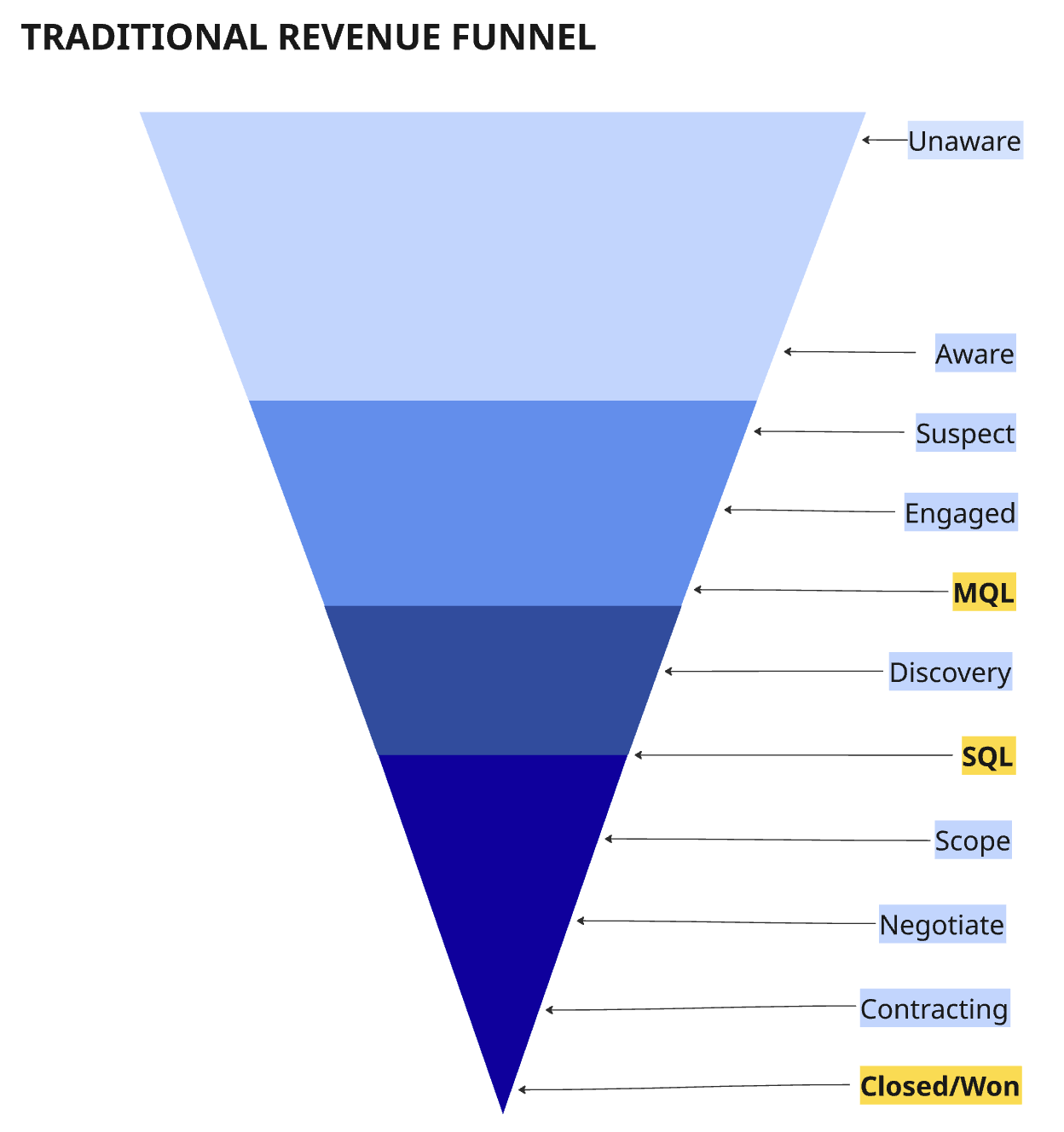
The Usual Suspect: a Marketing and Sales Funnel
The stages in your Revenue Funnel will vary, but these should be pretty close
The second step is to implement an authentic Lead With Help strategy for your existing customers.
the Bow Tie Funnel
Imagine your marketing and sales funnel. Since the goal of marketing and sales is to drive revenue, I like to draw the funnel that leads all the way to Closed/Won. This mindset is helpful if you do or don’t have a sales team or BDRs. Your funnel probably has stages like Unaware, Aware, Suspect, Engaged, MQL, Discovery, SQL, Scope, Negotiate, Contracting, Closed. Your terms will vary based on your business model, but let’s assume these are pretty close.
Now turn that funnel on its side. The list above starts at the far left and moves rightward. Now Closed/Won is at the right where the triangle is smallest.
Here’s the new move: draw another triangle whose narrowest point is opposite Closed/Won. It should look like a bow tie where Closed is the knot.
The stages of the new funnel are onboarding, educating, delivering repeatable value, renewal, and Client Success Qualified Leads. Boom.
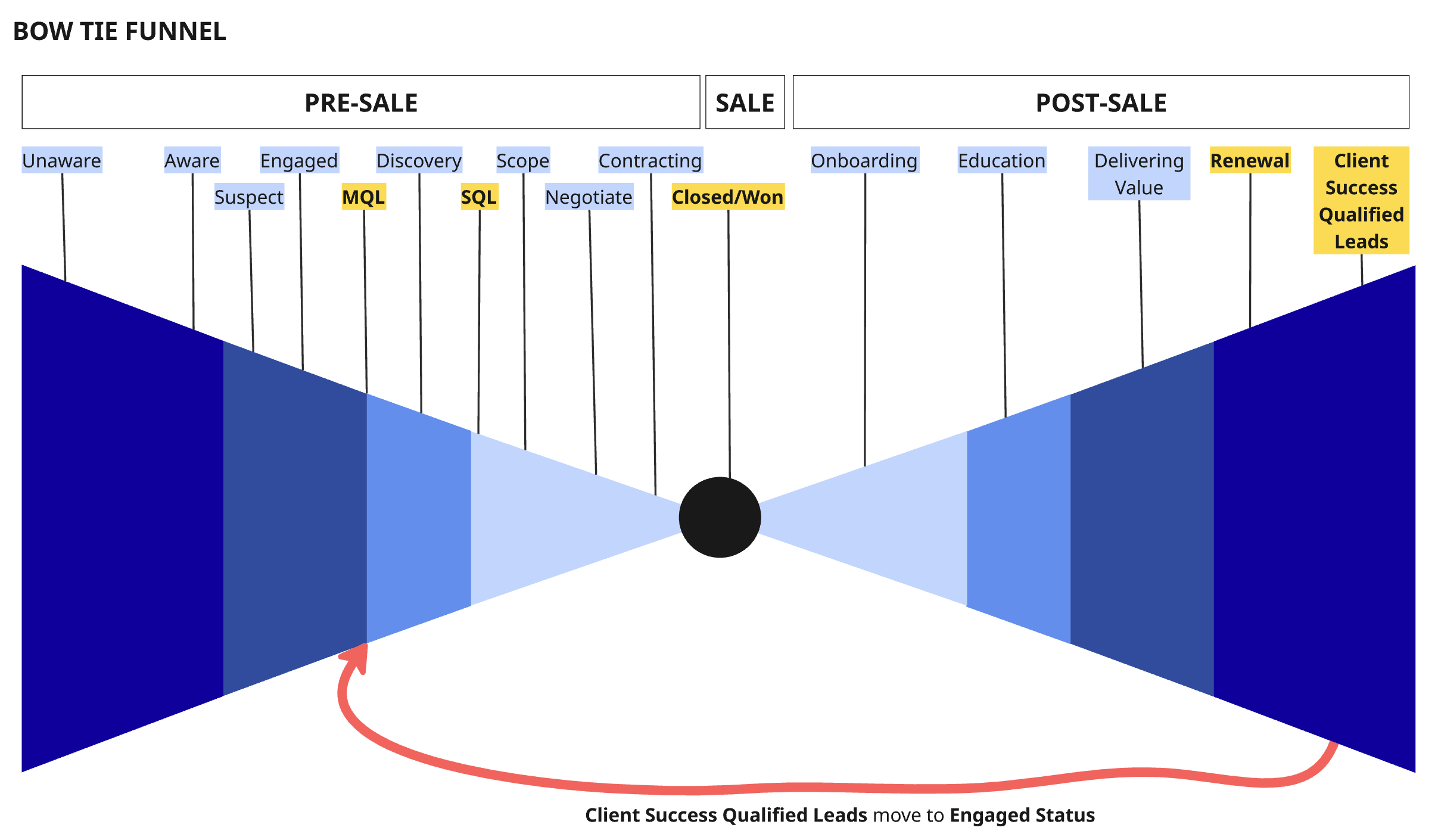
A Bow Tie Funnel revenue mindset focuses on the customer journey from Pre-Sale all the way through Post-Sale. The goal is for Client Success Qualified Leads to move into your Pre-Sale pipeline at Engaged. These leads are generated by your existing (happy) customers and do not carry the burden the same cost burden as your Unaware leads that come in at the top-of the-funnel.
Bow Tie Funnel + Lead With Help
The Bow Tie Funnel forces the unification your revenue strategy — pre-purchase to close to post-purchase — meaning that Lead with Help is integral to the customer journey from marketing (awareness) to sales (win the first deal) to client success (loyalty into continuing to win).
Tips for Lead with Help
New client onboarding that continually shows the stakeholder of the value of platform and highlights new features over the lifetime of use
Programs to make customers feel like insiders
Educational drip campaigns (your customers may not realize when new features are deployed. It’s on you to help them see the value of these as aligned to their industry)
Lead-with-help content marketing: are there other tools or solutions that you can create for your customers and prospects? Can you tout a cool new integration with another platform? Are users doing anything interesting with Zapier or Make to connect your platform to other tools?
Create durable artifacts: case studies, genuine thought leadership that comes from the minds of the humans running your company. Don’t use AI to create these.
Show not tell: client testimonials and user stories that show value without your company having to say that “we’re experts at xyz”
Humanize the brand: tell company stories that feature your client-facing employees and the back office team that makes everything work
Invitations to exclusive events (webinars, meet-ups)
Invitations to participate in proprietary research
Increase your brand content so that it acts as air support for your growth ad campaigns. The moment when you feel like pulling back on brand ads is exactly when you should do the opposite. Otherwise you put your growth ads at risk by asking them to do too much work: they have to introduce the brand and sell the solution.
Look for opportunities to surprise and delight your customers. I think of Slack adding fun icons and Easter eggs during Halloween.
Why does The list exclude NPS?
It’s my view that over-reliance on Net Promoter becomes a strategic risk because it can give a rosier picture than what people are feeling, and teams can hide behind it. Moreover I think there’s too much AI noise and too much competition for your customer’s budget to rely on a simplistic measurement tool.
Wouldn’t counting Client Success Qualified Leads, meaning customers who refer their peers, feel like a more sound measurement? Imagine adding it as a KPI: “we increased CSQL by 15% and saw those leads increase at x rate vs net new leads.” When done right, the cost to acquire is lower because you’re not using your growth marketing dollars to win over those customers.
What’s Next?
A Bow Tie Funnel revenue mindset focuses on the customer journey from Pre-Sale all the way through Post-Sale. The goal is for Client Success Qualified Leads to move into your Pre-Sale pipeline at Engaged. These leads are generated by your existing (happy) customers and do not carry the burden the same cost burden as your Unaware leads that come in at the top-of the-funnel.
Build a Lead with Help strategy to establish your experts and your company as the go-to SaaS solution for your clients and prospects. Combine Lead with Help with a Bow Tie Funnel to create an evergreen revenue channel from the leads generated by your Client Success team.
Click this link to talk about Lead with Help and a Bow Tie Funnel for your company.
Notes
*A healthy practice I’ve implemented when taking over a new marketing department is to cancel the corporate card that is on file for our SaaS platforms and then wait and see what happens when the card declines. We have a new card issued immediately so that we can drop in the new number if a critical platform fails, but it often bubbles up — especially in D2C engagements — that there are ghost subscriptions that no one remembers signing up for or what they do. This is also a great way to get the Finance Director on your side as a new marketing leader. They appreciate the cost review, especially if the finance team is accustomed to the old marketing myth of spend, spend, spend, and count later. Savings that come to mind include a ~$1,000 premium Vimeo account that a former team had signed up on auto-renew for to share hi-res, highly stylized (and beautiful) short-film brand videos with the intention of canceling (three years earlier). It adds up.
About James Burdine.
James is a successful marketing leader, strategist, and craftsman who blends proven growth strategies and voice of the customer insights to drive sales and build brands for companies that demand results.
Bishop Linville
Bishop Linville helps leadership teams understand their customers, articulate what makes them different, and build brands and names that accelerate growth.